

The fuel that never runs out
The case for renewable energy just got a lot stronger
Author
 Christian Guthier
Publication date 12 May 2026
The sun delivers more energy to Earth in one hour than the entire world uses in a year. We don’t need much of it – just enough daylight to generate the energy we need.
And unlike coal, gas, nuclear, or imported biofuels, the fuel is free, inexhaustible, and doesn’t run through anyone’s shipping lanes. That distinction matters more than ever right now.
Solar panels convert that daylight into electricity – and they don’t need direct sunshine to do it. They generate on overcast days, in diffuse light, through an English winter. With a lifespan of up to 40 years, a well-sited panel is a very long-term answer to a very old problem.
And before anyone says daylight stops at night – that’s what battery storage is for. Solar, wind and battery storage working together don’t just manage intermittency. A 2025 study published in Nature Communications found that a globally connected solar and wind system could generate more than three times the world’s projected electricity needs by 2050.
At Ray Valley Solar, we’re already putting that principle into practice – our battery storage project is the UK’s first community-owned battery attached to one of the largest community-owned solar parks. The technology exists. The fuel is free. Now, we need the investment to make it happen.
Fool me once…
In the past few years, the shocks have kept coming. Covid disrupted global supply chains and exposed how dependent we’d become on importing everything.
Then Russia invaded Ukraine, and gas prices across Europe went through the roof. Electricity bills followed – because in the UK, gas sets the price of electricity even when it’s not the main source of power.
In late February 2026, it happened again. Airstrikes on Iran effectively closed the Strait of Hormuz – the narrow waterway through which roughly a fifth of the world’s oil and liquefied natural gas passes every year. Gas prices spiked. Electricity prices followed.
Each crisis reveals the same vulnerability. This time, the response has been different. The government has moved to accelerate renewables explicitly because of the shock – not despite it. But the underlying problem remains: until we’ve built enough, every crisis still hurts.
But something is different this time. New analysis from Ember found that wind and solar capacity built since the last energy crisis avoided around £7 million a day in gas purchases during the latest shock. Electricity generation using gas was 39% lower in March 2026 than in March 2021 – because of renewables built in the intervening years. Every solar panel installed is a hedge against the next crisis.
The Energy and Climate Intelligence Unit puts it even more starkly: without renewables powered by UK wind, water and sunshine, 73% of the primary energy used to supply UK electricity would have been imported in 2025. Solar output alone grew 37% between 2024 and 2025 – the most of any technology type.

One shipment, decades of power
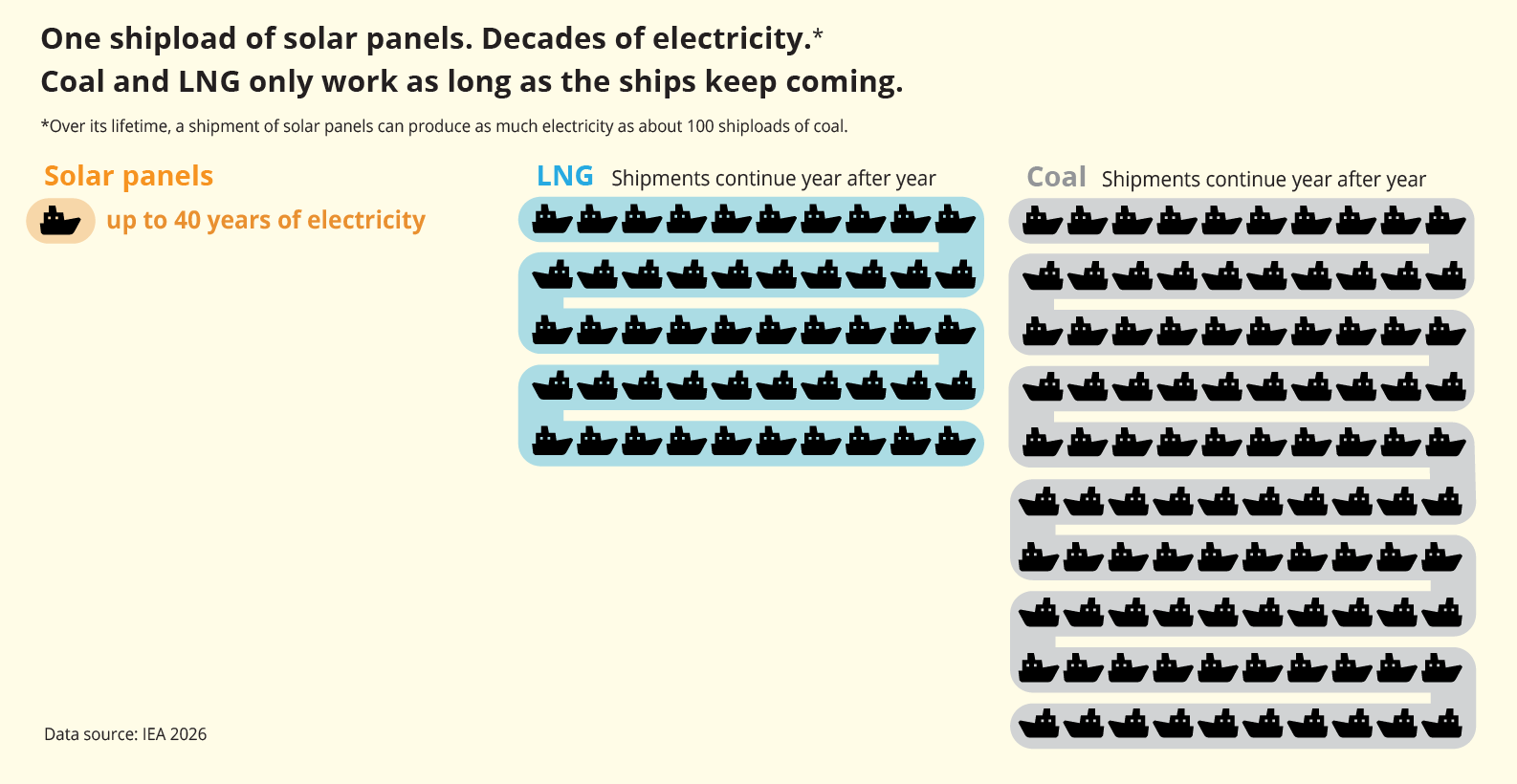
A shipload of coal, gas or oil delivers a fixed amount of energy. Burn it, and it’s gone.
To keep the lights on, you need another shipment.
And another.
And another.
Year after year, decade after decade, the ships keep coming – through the Suez Canal, the Strait of Hormuz, the North Sea, wherever the fuel happens to come from that week. Around 40% of everything shipped (Policy brief PDF) across the world’s oceans is fossil fuels – coal, oil and gas, moving from where they’re extracted to where they’re burned.
A shipload of solar panels is different. According to the International Energy Agency, over its lifetime a single shipment of solar panels can produce as much electricity as around 100 shiploads of coal. Ship it once. Generate for up to 40 years. No repeat orders required.
That’s not just an environmental argument. It’s a strategic one.
Clean from manufacture to end of life
The case for solar goes further than what happens once the panels are installed.
Manufacturing does use energy – that’s the honest answer to anyone who asks about solar’s carbon footprint. But according to the IEA, a modern panel offsets that manufacturing carbon within just a few months of operation – not years. It then goes on to generate clean electricity for up to 40 years.
Lifecycle emissions from utility-scale solar are around 33–50g of CO₂ per kilowatt hour – compared to 820g for coal and 490g for gas. That’s not a small difference. It’s a different category entirely.
And at the end of a panel’s working life, at least 85% of its materials – glass, aluminium, silicon – can be recycled and reused. In the UK, manufacturers are legally required to arrange that recycling free of charge. The sector is improving rapidly: renewable-powered factories, more efficient production processes, and better recycling technology mean each new generation of panels carries a smaller footprint than the last.
Solar is a technology that gets cleaner over time. Fossil fuels don’t.
What it means for your bills
Every unit of solar generation added to the grid reduces the number of times gas power stations set the price of electricity. Analysis from Ember has found that new wind and solar cut day-ahead wholesale electricity prices significantly – and that benefit flows through to households and businesses.
Battery storage is also changing the equation – the more solar we can store and dispatch when needed, the less often gas sets the price at all. Fixing the underlying market structure that ties electricity prices to gas requires political will beyond solar panels alone. But every renewable megawatt installed reduces our exposure to the next price spike.
The financial logic of solar mirrors its carbon logic. There’s an upfront investment – in panels, installation, grid connection. But once built, the fuel is free. No price spikes. No import dependency. No shipping lanes to worry about.
For investors in community energy, that same logic applies. The payback period on a well-sited solar investment can be measured in years, not decades – and the returns continue long after the initial outlay is recovered. Ray Valley Solar, Low Carbon Hub’s community-owned solar park in Oxfordshire, is a working example of what that looks like in practice.
The fuller picture
Two arguments are often made against solar. The first is that it’s bad for nature. The second is that it’s not really clean when you factor in manufacturing and shipping.
The evidence addresses both.
Our blog post Solar farms and wildlife makes the case that solar farms – managed well – are genuinely good for wildlife. The evidence from sites across the UK, and from our own projects in Oxfordshire, tells a better story than most people expect.
This post makes the complementary case: that solar is cleaner than fossil fuels from the moment the panels leave the factory to the moment they’re recycled – and that the energy security argument for building more of it has never been stronger.
The fuel is free. The sun keeps shining.
And every panel we install is one less reason to worry about what’s happening in the world’s shipping lanes.
The fuel that never runs out is one part of the story. We’ve also looked at what solar farms mean for wildlife and biodiversity: Solar farms and wildlife.