

Thinking about getting air conditioning?
Author
 Christian Guthier
Publication date 12 August 2026
If you’ve had a few nights over the last few months where sleep felt impossible and your home turned into an oven by mid-morning, you’re not alone. This summer has been brutal for a lot of people, and it’s entirely reasonable to be thinking about doing something about it.
The scary thought is that heat waves may well be becoming a regular feature of European summers. What used to be a rare event could now happen multiple times a season, and the scientific consensus suggests this may well be the new summer pattern, not a series of freak events but a fundamental shift in what summer means. So the question isn’t really whether to act. It’s what to invest in.
Worth knowing before you go further: only around 5% of British households currently have any form of air conditioning, against 37% globally, so if you’re starting from nothing, you’re in the majority, not behind the curve. [Source: Centre for British Progress]
Air conditioner as an easy option?
Right now, installing a standard Air Con (AC) is generally easy, though a couple of things are worth knowing before you commit. It uses a refrigerant, so by law it has to be installed by an F-Gas certified engineer. Only portable units can be self-installed. And the automatic no-planning-permission route that applies to heat pumps doesn’t cover units that only cool, so it’s worth a quick check with your council. Beyond that, it’s a straightforward purchase.
That’s the whole point of this: could you get more for a similar amount of money? Yes, you can, and several homeowners further down this post have been living with the alternative for years, and are still “very happy with the end result, both financially and technically.”
Same install, but get more for your money?
An air-to-air heat pump (A2A) looks identical to a standard AC unit: same outdoor box on the wall, same indoor unit, same kind of installation. But A2A wins on the law. Because it heats as well as cools, it qualifies for the domestic heat pump permitted development right, so in most cases you won’t need planning permission (subject to conditions like MCS certification, unit size and siting). A cooling-only AC unit is excluded from that route altogether, so plain AC is the one more likely to need a council check first.
A2A is easy to confuse with an air source heat pump (ASHP), since both have “air” in the name. They’re not the same thing, though they share that same permitted development route. A2A cools and heats rooms directly through wall units, just like AC. ASHP heats water for a central heating system and hot water cylinder, and is a bigger, costlier job. More on that difference further down.
The thing that matters here is what A2A actually does. When you compare the two systems: a standard AC unit cools your home for a few weeks in summer, then sits idle for the rest of the year. An A2A heat pump cools in summer and heats in winter. One system, doing both jobs.
What does it actually cost?
The quick answer is that it varies. For a single room, AC typically costs around £1,500 to £3,000 installed, and A2A comes in at a broadly similar £2,000 to £4,000. At that scale, the gap is small.
Where it changes is multi-room and whole-house systems. Costs scale up with the number of indoor units regardless of which system you choose, but a full-house A2A setup, several rooms, one outdoor unit, can run well beyond the single-room figures, more like £4,000 to £9,500. Nikki Lambert’s own five-zone system, covered below, sits toward that end of the range, and one of the case studies further down came in above it, so treat this as a guide rather than a ceiling.
So the short version is: for one or two rooms, A2A costs about the same as AC. For a whole house, it costs more, but you’re also replacing what would otherwise be a separate winter heating cost. (Checkatrade’s heat pump vs air conditioner cost guide is a good place to sense-check current figures if you want to find out more.)
Both AC and A2A are similarly efficient for cooling, operating at a coefficient of performance of around three to four, meaning one unit of electricity gives you three to four units of cooling back. Where they differ is what happens the rest of the year.
The winter argument
This is the part that changes the calculation. If your A2A is handling winter heating as well as summer cooling, you’re not just buying a comfort upgrade for a few weeks a year in summer. You’re reducing your dependence on your gas boiler, or replacing it altogether in a well-insulated home. Put in one unit of electricity, get three to four units of heat back. That’s a fundamentally different way of heating, and as the grid gets cleaner and solar becomes more accessible, it only gets more attractive.
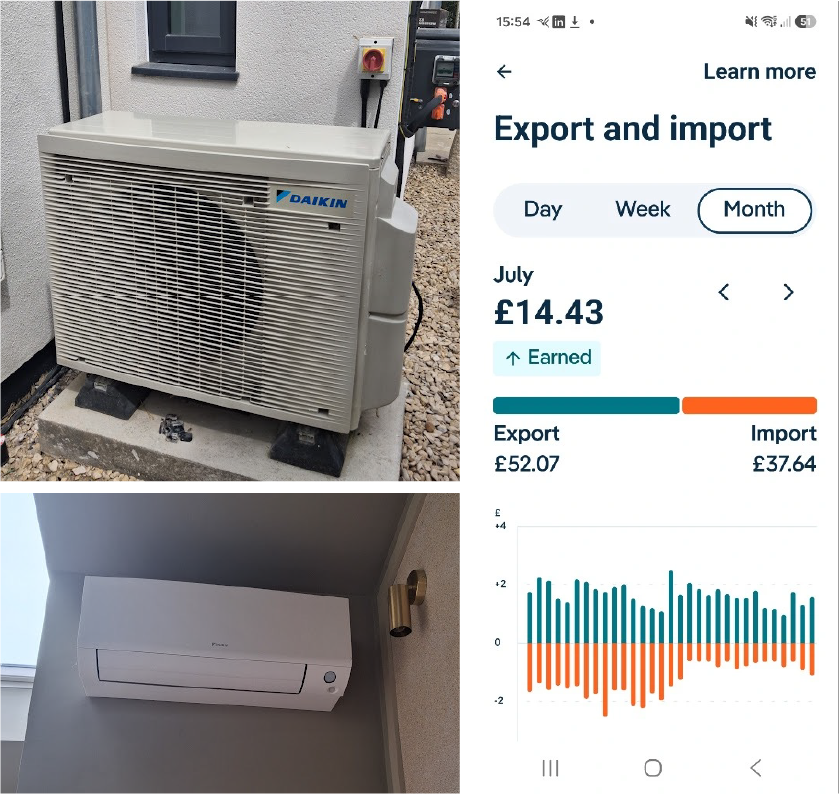
Nikki Lambert, at Lambert Home Builds, has seen this play out in her own home. She’s paired her A2A with solar panels and a battery, and for the whole of July, covering cooking, hot water, cooling, everything, they didn’t pay a penny for energy. In fact, they earned £14.43 from exporting surplus power back to the grid. A2A on its own already makes sense if you want cool summers and warm winters at running costs similar to what you’re likely paying now. Add solar and storage, and that’s where your investment really pays off.
(Nikki also points to a less obvious benefit: solar panels shade the roof, reducing the heat that gets through into the rooms below. Cooling and clean energy from the same installation.)
Insulation and airtightness
There’s always a but. Before you buy anything, it’s worth asking how well insulated and how airtight your home actually is, because it changes what A2A can do for you. Good insulation keeps the heat A2A puts into a room in winter, and the cool it puts in during summer, from leaking straight back out, so you get more from every unit of electricity you put in.
A well-sealed, less draughty home adds to that: it lets an A2A unit hold a temperature rather than fighting a losing battle through gaps and draughts. Between the two, you may find you need less cooling capacity than you thought, or none at all, and a smaller system costs less to buy and run. Loft insulation in particular is relatively cheap and makes a meaningful difference.
CASE STUDY
A loft that works, in every season
When Richard and Jenny downsized to their present home, Richard immediately started on essential improvements, prioritising solar panels and a battery, which helped halve their electricity bills.
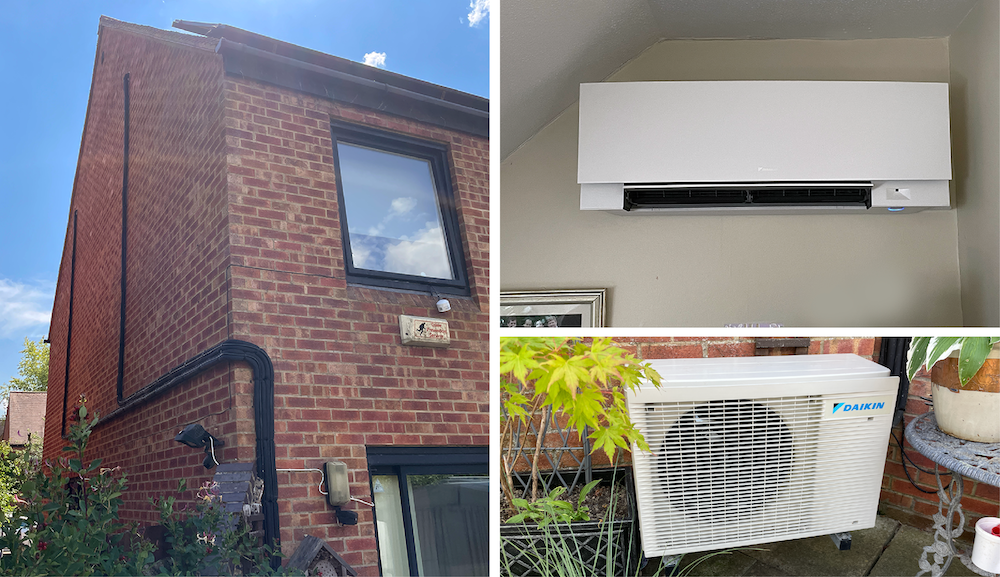
Both in their eighties, they’d chosen a house with three floors, giving each of them their own bedroom, office and bathroom on separate levels. Jenny took the top floor, under the loft, but soon found it too cold in winter and too hot in summer, sometimes having to move down a floor to sleep during heatwaves.
After researching options, Jenny chose Daikin A2A units. Two were fitted high on the walls of her bedroom and office, in a single project by MGi, an Eynsham-based firm, with the outdoor unit positioned in the back garden. Installation took two days and cost just under £5,000.
“The A2A heat pump? Absolutely no complaints, the units are an absolute boon. Within minutes I get hot or cool air when needed, and the running cost is offset by the electricity our solar panels save us. I suffer from allergies, and the units we chose have efficient built-in air filtration too. Now that our summers bring such excessive heat, and given I have several age-related health conditions, I’m endlessly grateful we made this choice.” Jenny
Think long term
The climate is not going back to what it was any time soon. Heat waves will keep coming, probably more frequently and probably more intensely. That changes how you should think about any investment you make in your home.
A basic AC unit solves today’s problem. An A2A heat pump solves today’s problem and tomorrow’s heating bill. Add solar panels and a battery into the mix, and you’re generating your own clean electricity, cutting your energy costs year-round, and running your heating and cooling largely on power you’ve produced yourself. Each of those is a long-term investment that pays back over time. Together, they compound.
There’s a health case here too, not just a comfort one. High temperatures carry real risks, increased illness and even mortality, particularly for older people and other vulnerable groups. The ability to cool a home properly isn’t just about a good night’s sleep; it’s a genuine protective measure.
None of this means you have to do everything at once. But it does mean thinking past this week’s heat, or this year’s spend, and asking what you actually want your home to look like in ten or twenty years.
So, what to do?
You were going to spend money on cooling your home anyway. The question is whether you spend it on something that works for six weeks a year, or something that works year-round, heats more efficiently than what you’ve probably got, and still has years of life left when a basic AC unit would need replacing.
For a single room, the upfront cost of A2A is close to AC. For a whole house, it’s more, but it’s replacing a winter heating cost too. The long-term case is straightforward.
A quick note on A2A vs ASHP
Yes, they both have “Air” in their name, they both exchange heat with the air, but they work differently.
An Air Source Heat Pump (ASHP) is the bigger, costlier job: a full wet central heating system and hot water cylinder, a certified installer, a proper heat loss survey, and typically £8,000 to £14,000 before the £7,500 government grant.
An Air to Air Heat Pump (A2A) doesn’t heat water or connect to radiators, but it’s simpler and cheaper to install, and it now has its own £2,500 government grant too. Take-up so far has been low, but that’s not a verdict on A2A itself: most people simply don’t know the grant exists yet, and the installer accreditation paperwork behind it is still catching up. Worth checking current status with an installer. If you’re starting from “I need to cool my home this summer,” A2A gets you a long way further than AC for not much more money in most cases.
That trade-off wasn’t theoretical for Anna Railton, below, whose own ASHP quote came back double the cost of A2A.
CASE STUDY
The cost gap in a hard-to-heat house
Anna Railton’s four-bed house, built around 1995, is a useful test case precisely because it wasn’t an easy one: old microbore pipework meant a standard air source heat pump was quoted at £30,000. A full A2A system came in at £15,000.
Four units were fitted in August 2024, two upstairs and two downstairs, each independently controllable, so rooms can be heated or cooled on their own rather than as one zone. The house is off gas entirely: no radiators, just a small electric hot water tank, plus 1.6kW of solar. Running costs have come out similar to her old heating system. Annual servicing, including filter changes, is £300.
She didn’t get a grant at the time of her install, but points to the same behaviour-change gap that keeps ASHP adoption down: with ASHP, she says, “you just have to have constant heat on all the time, and it’s not full heat, it’s just warm,” while A2A will heat or cool a room on demand, “the way you’d like it,” with no change in habits required. She also notes a smaller but real upside: losing radiators frees up precious wall space.