
Community benefit from renewable energy
Author
 Beth McAllister
Publication date 31 March 2026
The UK is building renewables faster than at any point in its history. But as solar farms, wind turbines, and battery storage spread across the countryside, a quieter question is becoming urgent: are the communities hosting this infrastructure actually sharing in its value – or just living with it?
Our second Community Energy Insights webinar of 2026 brought together community energy groups, local authority officers, investors, and advocates to explore exactly that. Mairi Brookes, our Smart Energy Systems Director, led the session. With over 16 years of experience spanning sustainability policy, electricity market reform, community energy, and EV infrastructure – and a background that includes time at Oxford City Council – she’s well placed to dig into what meaningful community benefit really looks like in practice.
Read the full summary below – or watch the full recording.
What do we mean by “community benefit”?
Mairi started by unpacking the terminology, because working towards a shared language is important. The term “community benefit” gets used broadly across the sector, sometimes to describe the carbon benefits of clean power generation, sometimes to refer to specific funding and what it supports, and sometimes as shorthand for a particular programme or achievement.
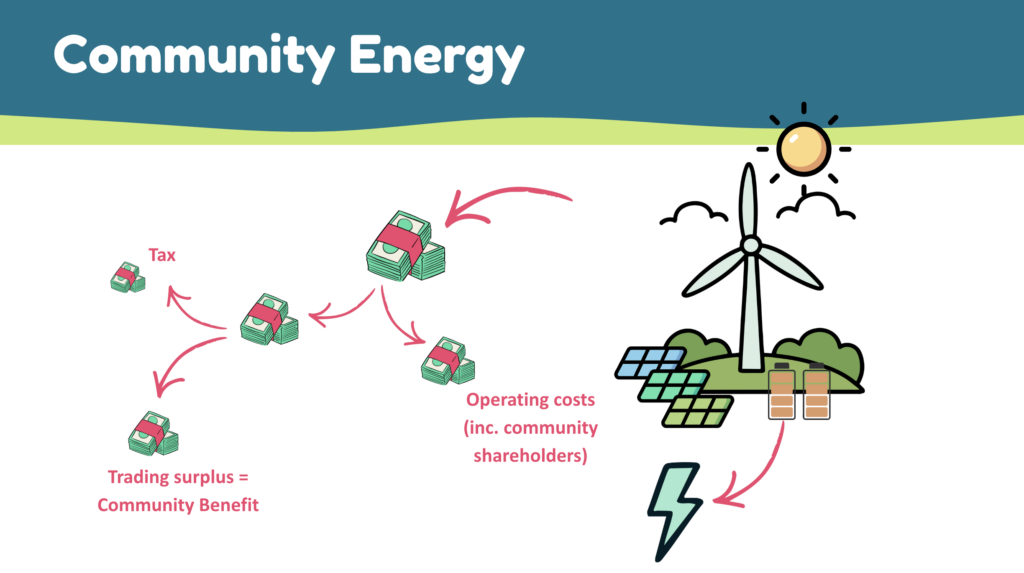
At Low Carbon Hub, as a community benefit society, community benefit is built into the model. We sell the power we generate, cover operating costs, pay a fair return to our investor members, and use our surplus to fund our impact work. 100% of our surpluses are invested into the community, and our direct surpluses alone have generated over £1.5 million of community benefit to date – with much more leveraged in through partner funding alongside that.
By contrast, in a traditional privately owned model, community benefit contributions tend to be a voluntary fund – often relatively modest – set aside from profits that are otherwise distributed to shareholders. The purpose of the model is fundamentally different, and so is the scale of benefit it generates.
What does community benefit look like in practice?
To bring this to life, Mairi walked through our impact programme, which focuses on five pillars: leadership, partnership and advocacy; community energy group support; non-domestic energy; home energy and fuel poverty; and community action plans for zero carbon energy.
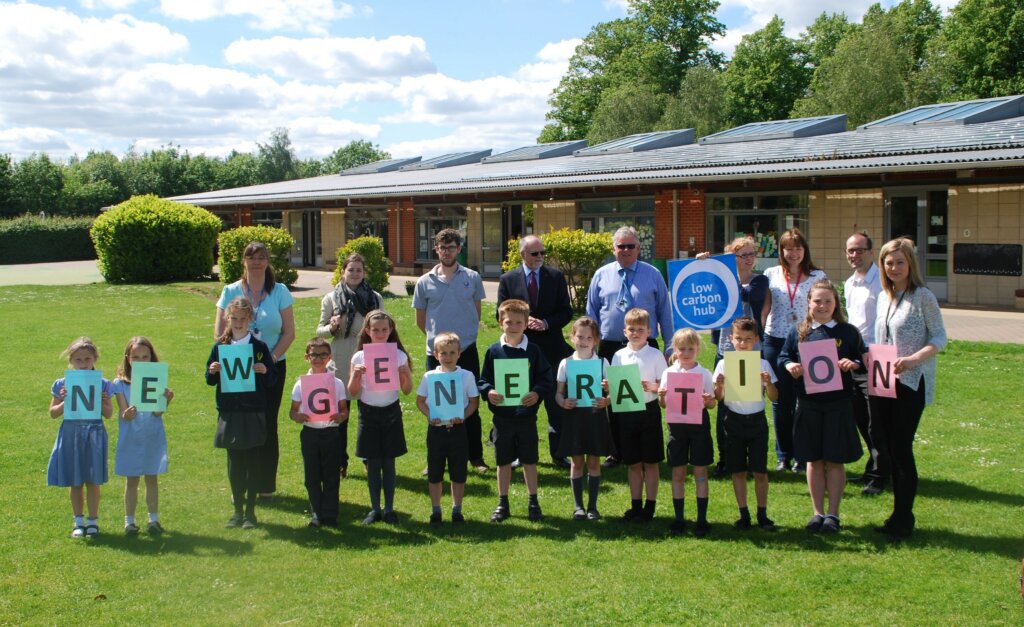
A few highlights
Community energy group support. The energy transition happens at a local level – it relies on people making decisions, supporting new infrastructure, and advocating for what’s fair in their area. Community energy groups have an irreplaceable local voice. But time and volunteer energy are scarce, which is why the coordination and support that our Community Energy Manager, Cathy, provides is so valuable.
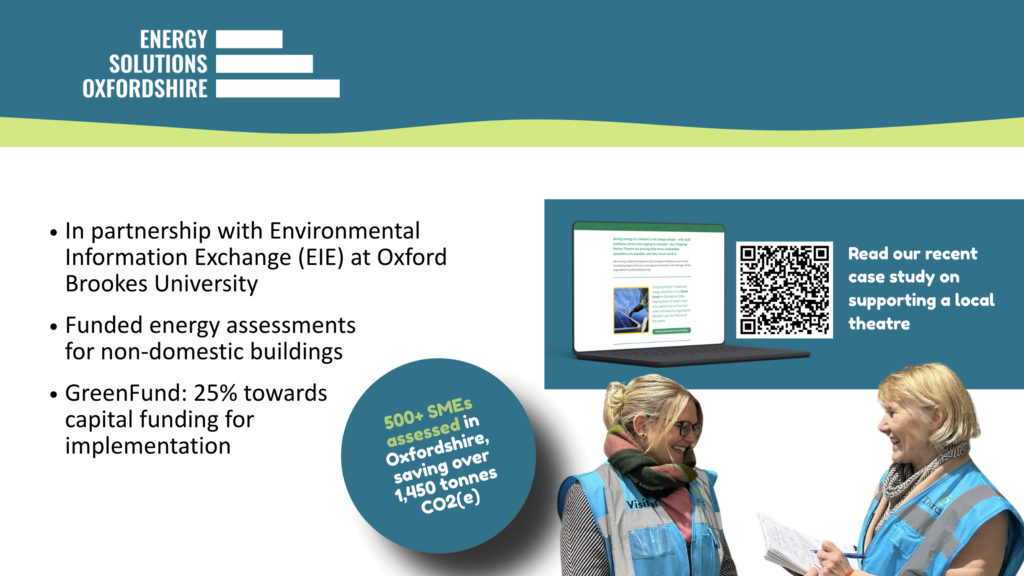
Non-domestic energy. Our Energy Solutions Oxfordshire (ESOx) programme supports SMEs through building energy assessments and part-funding for measures, with hands-on support from the team. The combination of funding, practical help, and a deadline is what makes change happen faster.
Home energy and fuel poverty. From Cosy Homes Oxfordshire – a coordinated home retrofit service developed in partnership with Retrofit Works – to our crowdfunded Energy Advice Programme, which trained eight volunteer energy champions in response to the 2022 energy crisis, this strand is about making the transition fair and accessible for everyone.
Community action plans for zero carbon energy. Working at a place-based level to make the transition to zero carbon energy meaningful for communities – from county-level targets down to a street-by-street reality. We piloted this with low carbon community groups in Eynsham and are now applying what we learned to the Leys, Stadhampton, and the Baldons area.
How does this compare to voluntary contributions?
Mairi offered a rough comparison, with caveats that these are approximate figures. Low Carbon Hub spent around £500k last year on community benefit – divided by our 25 MW of installed capacity, that works out at around £20,000 per MW.
For context, the Scottish Government-backed benchmark for community benefit contributions from wind farms is £5,000 per MW. Botley West, the large proposed solar farm in Oxfordshire, has a reported community benefit contribution of around £525 per MW. And Mairi noted she’d seen other examples where contributions, on closer inspection, amount to as little as 25 pence per MW.
The point isn’t to make a precise like-for-like comparison – there’s nuance behind any single figure – but to illustrate the order of magnitude difference that community ownership makes.
What is the government doing?
Mairi gave an overview of recent policy milestones:
Clean Power 2030 Action Plan (2024): Sets out ~£40bn of annual investment in clean generation, storage, flexibility, and grid reform.
Working paper on community benefit contributions and shared ownership (May 2025): Considered whether contributions should be mandated, what the threshold and benchmark should be, and how shared ownership might interact with contributions. Low Carbon Hub responded in favour of both, arguing that percentage of income would be a fairer benchmark than pounds per MW.
Local Power Plan: Expected to be a landmark for community energy, the plan turned out to be more modest than hoped. It includes £1bn of funding, which, while significant, is less than earlier signals indicated, an ambition for 1,000 community-owned projects, and, critically, a focus on mandating shared ownership rather than community benefit contributions. Funding is channelled through Great British Energy and through partnerships with combined authorities and strategic mayoral authorities.
That last point matters for Oxfordshire, because we don’t have either of those structures. Local government reform is also adding complexity: the anticipated changes to local authority structures are likely to slow decision-making on significant spending commitments, at least in the short term.
What does this mean for Oxfordshire?
Mairi drew on analysis from Oxfordshire County Council to set out where we are:
- Around 364 MW of renewable generation and storage in the county as of 2025
- 41 MW (11%) is community owned – already exceeding the national ambition on a per-capita basis
- A known pipeline of around 4,000 MW of potential projects already in the planning or connection queue
- Oxfordshire’s pathway to zero carbon targets 5,300 MW of capacity by 2050
The striking finding: over 70% of the 2050 target is already in preparation. That means the window for securing community ownership of those assets is now – because once they’re built, the opportunity to negotiate shared ownership largely closes. Mandation, if it comes, won’t be retrospective.
Mairi’s call to action for Oxfordshire: we need an Oxfordshire partnership for community-owned energy – a coordinated structure for community energy organisations to identify shared ownership opportunities, engage developers, build collective capacity, and provide a strategic channel for funders and financiers. Acting now, before projects are consented and built, is essential.
Q&A highlights
On engaging funders and finances strategically: GB Energy has a live call for expressions of interest on its website – community energy groups and organisations at any stage of development are encouraged to register their projects.
On the complexity and pace of shared ownership: The sector already has the capability to make this happen, particularly through existing community energy organisations. Templates and legal documents are being developed by GB Energy in 2026. There is precedent – including in Scotland and across Europe – for shared ownership of commercial-scale projects.
On equity between regions: Oxfordshire’s 11% community ownership already exceeds the national ambition. That reflects the strength of our local sector. There are real questions about what organisations like ours can do to help develop projects elsewhere – including building early-stage projects and transferring them to local communities.
On local government reorganisation and funding: The structural changes underway in local government are likely to create delays for significant spending decisions. This is a real risk for Oxfordshire’s ability to access partnership funding through the Local Power Plan, at least in the near term.
What can you do?
- Join or set up a community energy group – if you’re in Oxfordshire and not already part of our network, we’d love to hear from you.
- Invest in our portfolio through our Community Energy Fund.
- Use our help desk – open to anyone who wants to pick our brains, whether you’re a community group, local authority, or parish council trying to negotiate a community benefit contribution.
- Register your project with GB Energy via their expressions of interest form.
- Our most recent webinar focused on batteries and our Ray Valley Solar site – watch the recording or read the summary.
- Sign up to our regular newsletter, or watch our website for details.
You can watch the recording of this webinar on our YouTube channel. If you have a question that wasn’t answered on the day, get in touch via our help desk.