
Why battery storage is the next step for community energy
Author
 Beth McAllister
Publication date 1 April 2026
On 26 March 2026, Low Carbon Hub hosted its latest Community Energy Insights webinar. The session brought together investors, supporters, and community energy enthusiasts to explore battery storage co-located with renewable generation – that is, batteries installed on the same site as solar panels – and what it means for the UK’s energy transition.
Our CEO Barbara Hammond and Renewables Portfolio Director Tim Jones shared the story behind our decision to invest in a battery at Ray Valley Solar – and what it means for the wider community energy sector.
Here’s a summary of what was discussed:
Why battery storage, and why now?
The UK’s energy transition depends on storage. Renewables are intermittent – the sun doesn’t shine at night, and the wind doesn’t always blow – so if we want a clean grid, we need somewhere to put the energy we generate at peak times and release it when it’s needed most.
Barbara outlined three broad categories of battery storage – domestic, large-scale commercial, and community-scale co-located with generation – with the third being where Low Carbon Hub sees the most opportunity.
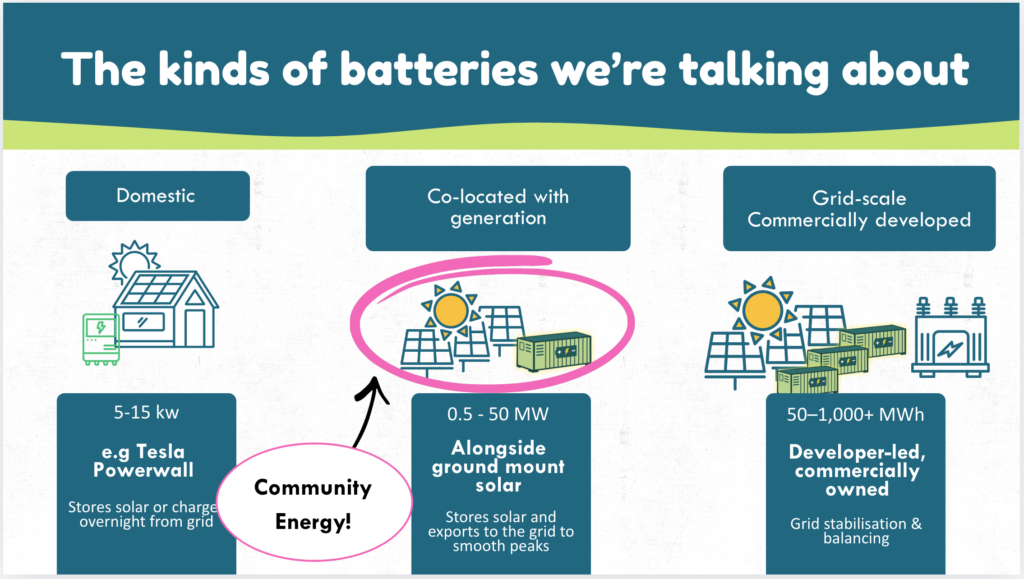
The timing is significant for two reasons. First, lithium-ion battery technology has matured considerably – it’s now reliable enough to underpin investment decisions. Second, costs are falling sharply, following a similar curve to solar PV in the early 2010s. As Barbara put it: “Just like deciding when to buy a new computer, at some point you have to decide when to dive in.”
The challenge at Ray Valley Solar
Ray Valley Solar is one of the largest community-owned solar parks in the country. It generates 19.5 GWh annually – equivalent to the electricity needs of around 7,000 homes – and will deliver over £13 million in community benefit across its lifetime.
But after two successful years of operation, a problem emerged. The solar farm can produce more electricity at peak times than its export connection can accommodate. When that happens, the surplus has to be ‘clipped’ – essentially grounded and wasted. We’re currently losing over 800 MWh of clean electricity a year this way, which translates to around £70,000 in lost revenue annually.
There’s also a bigger structural issue on the horizon. When solar farms first came online fifteen years ago, over 99% of all solar generation was accommodated by the market. Today that figure is already closer to 85%. As more solar capacity is built, ‘capture rates’ – the proportion of generated electricity that can actually be exported and sold – are expected to keep falling. The current system of Contracts for Difference, which compensates generators even when told to shut down, won’t be financially sustainable at scale.
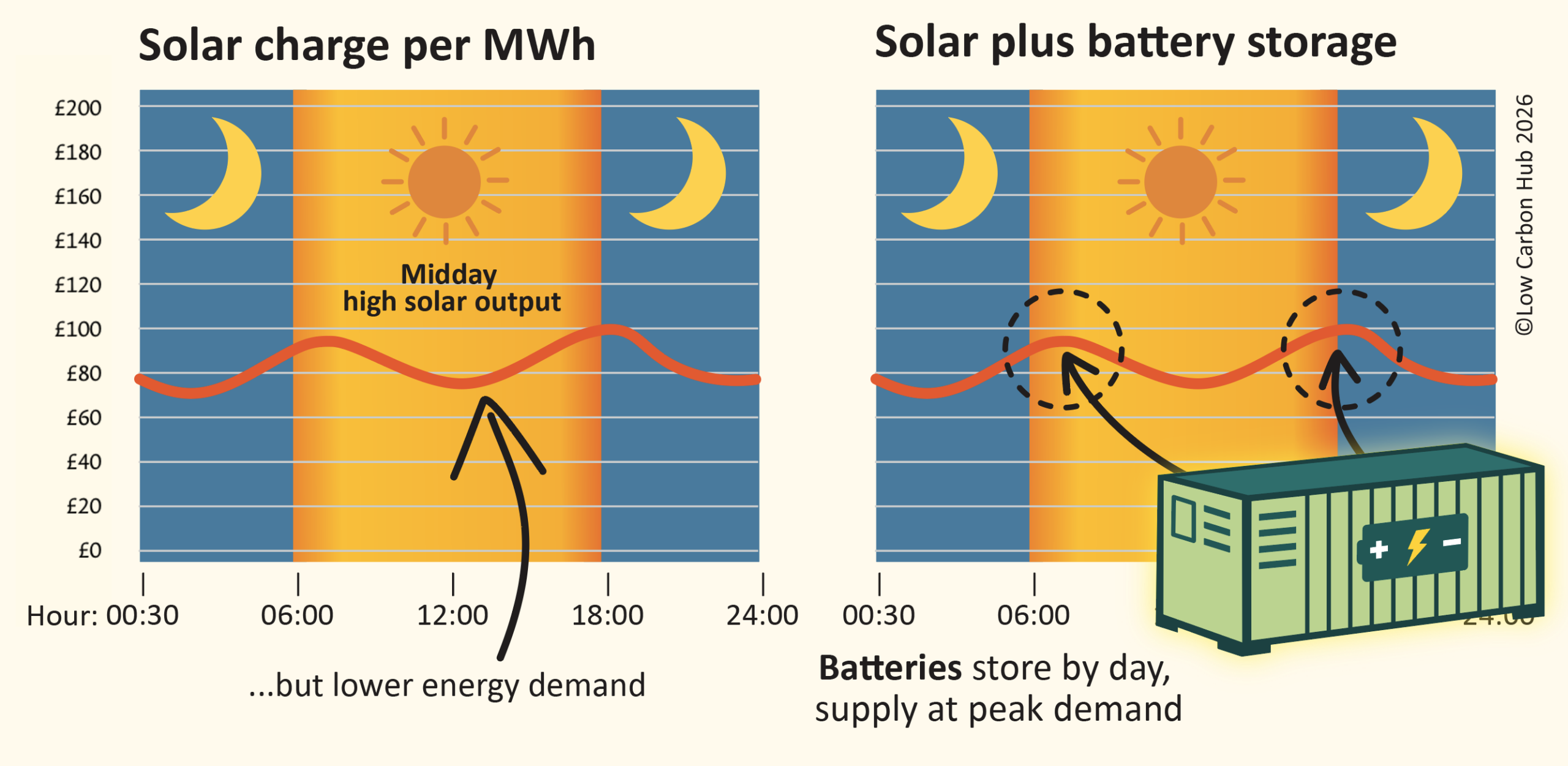
A battery solves this directly: store the surplus at midday, dispatch it during morning and evening peaks when electricity commands a higher price. It’s the difference between a solar park that works office hours and one that works around the clock – which is exactly the idea behind our Solar 24/7 campaign.
A £1.8 million investment in battery storage
n December 2025, Low Carbon Hub made the decision to invest £1.8 million in a 3 MW, 12 MWh battery at Ray Valley Solar.
Here’s what that means in practice:
- A 3 MW battery with 4-hour duration can discharge twice daily – for the morning peak and the evening peak.
- It will recover the 800+ MWh of electricity currently being lost each year – enough to power around 300 more homes annually.
- Annual operating and maintenance costs will be around £40,000–50,000.
- The battery will be co-located on spare ground at Ray Valley Solar, maximising ‘round trip efficiency’ (the less distance between connections, the less degradation over its lifespan).
- The battery starts at 99.4% efficiency and is modelled to reach 72% by year 15, at which point it is over 96% recyclable.
Importantly, the revenue from recovering lost generation alone isn’t sufficient to justify the investment. The battery’s financial case also relies on arbitrage – trading the difference between cheap off-peak electricity prices (currently around 6p/kWh) and more expensive peak rates (around 12p/kWh, and much higher in volatile periods).
That means a mindset shift: from the relative security of a Power Purchase Agreement to a more dynamic, market-linked model. Having the battery as a supplement to an already well-established asset like Ray Valley Solar puts us on a much stronger footing.
What we’ve learned
Tim was candid about the complexity of battery projects and the importance of going in with clear eyes. Key lessons from the Ray Valley process include:
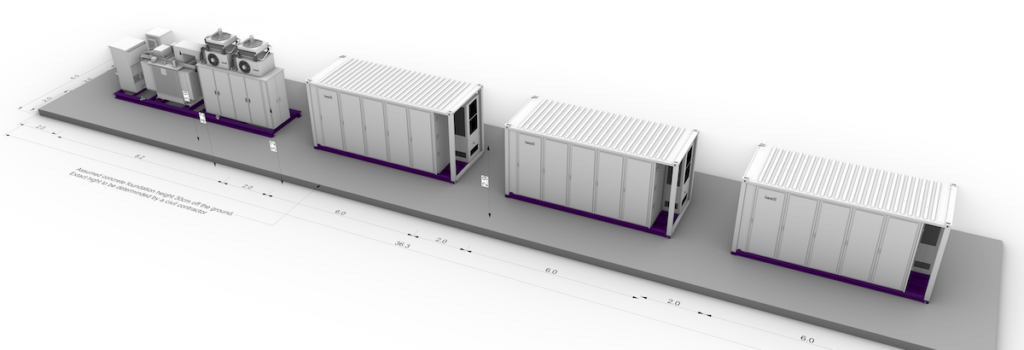
- Physical space matters. A single megawatt of battery storage is roughly the size of a shipping container. Three megawatts means three containers, plus a concrete pad, site access, and planning consent.
- Planning ahead is essential. Ray Valley Solar’s original planning permission included up to 20 MW of battery storage, so we only needed a non-material amendment to proceed. Other sites may need to start from scratch.
- Grid connections are a significant bottleneck. The battery applications queue is around seven times oversubscribed. However, sub-5 MW batteries can be approved by Distribution Network Operators without reference to the transmission system – a meaningful opportunity for community-scale projects.
- Expert advice is non-negotiable. From grid applications to financial modelling, the decisions involved are too complex and site-specific to navigate without specialist support. There is no one-size-fits-all approach.
- Fire safety is a material consideration. We deliberately chose a battery system with built-in internal fire suppression, enhanced separation from the solar farm, and improved emergency vehicle access.
Solar 24/7: Batteries and the energy transition
Beyond the commercial case for Ray Valley Solar, there are wider benefits to this kind of project that are harder to quantify but no less real. A battery doesn’t just recover lost revenue – it means solar energy can work around the clock, not just when the sun shines. That’s the idea behind our Solar 24/7 campaign.
The UK faces a £30–60 billion bill to upgrade the national grid. Every community-scale battery that reduces local demand on the transmission network helps bring that figure down – and reduces the physical disruption that comes with major infrastructure works.
As Barbara noted, the UK has a growing and influential community energy sector. As the battery market develops, it will be important that community energy organisations are learning alongside their commercial counterparts – and sharing that knowledge through bodies like Community Energy England.
How you can be part of it
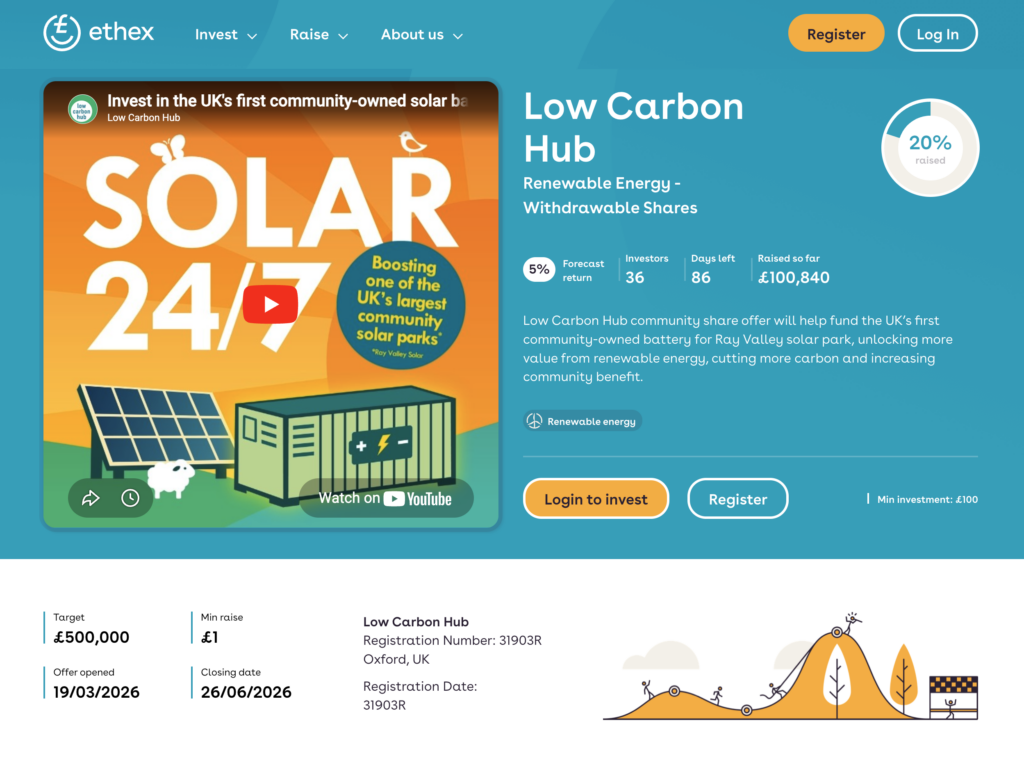
We’re inviting our community to invest in the Ray Valley Solar battery through our share offer, open now on Ethex. This is a chance to support the next chapter of community-owned clean energy in Oxfordshire – and to help us move towards solar power that works around the clock.
Stay updated
We’ll be sharing updates on the battery’s progress as the project moves forward, and hosting further webinars in our Community Energy Insights series.